
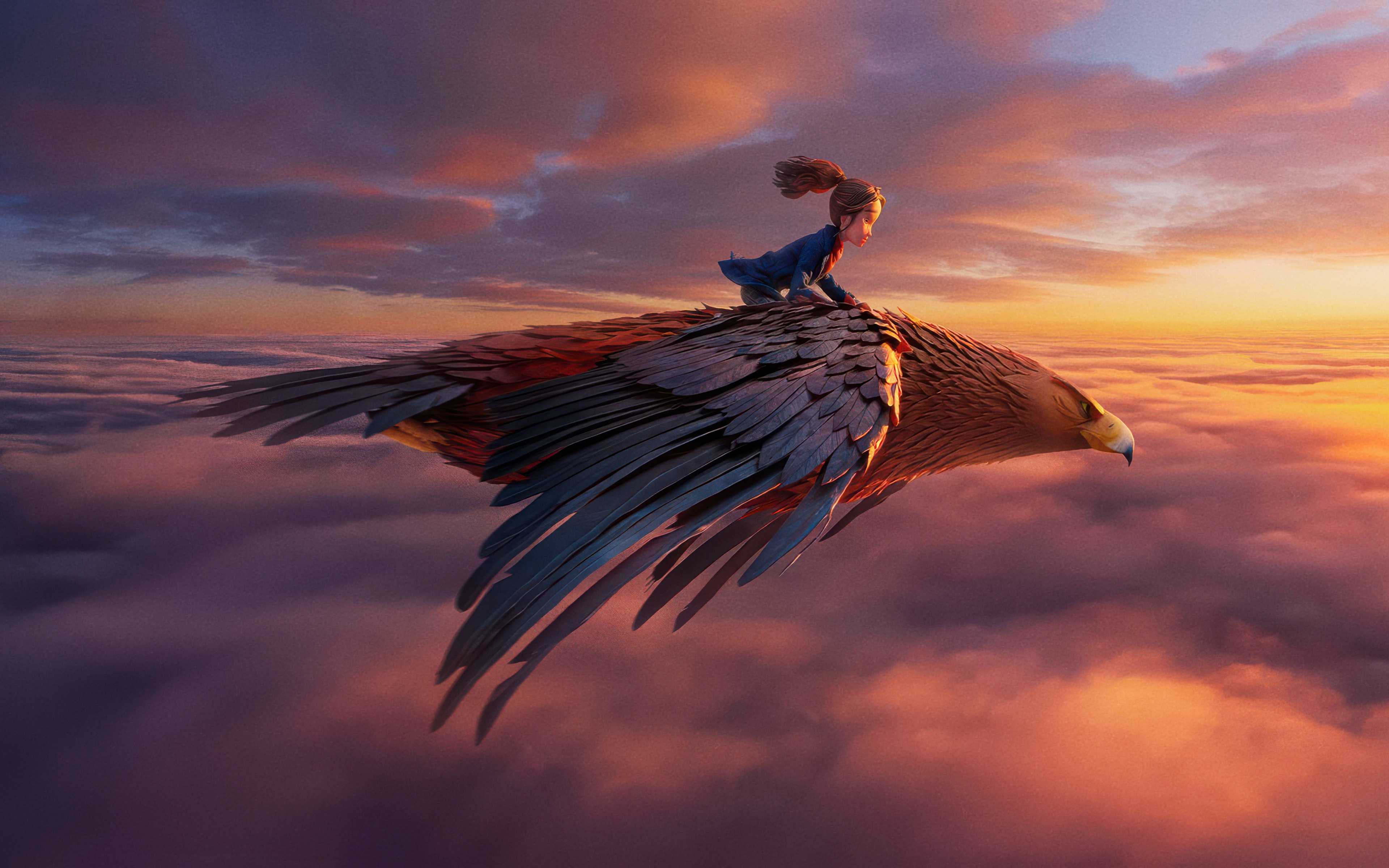
Watching Wildwood, I felt grateful that its imagined world had been made physical. Some thoughts on stop-motion, fairy tales, and why the human work behind an image matters to me.
I’ve been outspoken about my love of stop-motion animation before, see here, here, and here. There’s something I find deeply comforting about the smudgy fingerprints on the face of Gromit – like little artefacts left by the person working on the puppet preserved on film. LAIKA Studios takes a different approach from the early days of Aardman, of course. They blend CGI and use technology to create stunning scenes like the expansive ocean backdrops in Kubo and the Two Strings. I am not a stop-motion purist, and I also don’t think LAIKA’s choice to blend handmade puppets and modern technology is a progression of pure stop-motion – it’s just a different way of doing things.
As a writer, I am anti-generative AI in the creative fields. There used to be a time when I would check the pingbacks of Screen Waffle and find my articles referenced in student essays or on other film blogs. Now, a lot of them are just robot websites, talking to robots, and being read by robots. (If you have found yourself in a similar situation, it can help to visualise them all as Wall-E).
As LAIKA Studios has grown, the fluid movements of the puppets sometimes look fully computer generated, even though we know they are not. Even still, when I was watching Wildwood, I didn’t feel like the level of perfection reached by making stop-motion animation look so seamless detracted from the visual style. The power comes from knowing that the characters are real physical objects.
I read on Creative Boom that Wildwood is the longest stop-motion film ever made, with 231 puppets and 136 sets. The behind-the-scenes footage and images available online begin to give an impression of scale that goes beyond the post-credit scene. I think it’s the analogue nature that connects early stop-motion like Foky’s Scenes with Beans to Wildwood. Just knowing that the majority of the film is handmade makes me feel a sense of the journey from an imagined world to one that materially exists.
It is much easier to type this article and share it online than it is to ink however many copies, find people with similar interests, and distribute them personally. I think technology is great, and if it can be used to enhance something or make a process more efficient then you should use it – if you want to. I say this to address the distinction between valuing technology as part of a creative practice and treating the resulting image as the only thing that matters. Similarly, there’s a difference between synthesis and the synthetic.
When I was a postgrad student, I took a module on philosophical issues in art history and visual culture. I wrote a paper on whether computers can be creative – a topic I remember was gaining traction in the late 2010s. There were a lot of contemporary papers and books on the subject, and I remember my answer was no, because I thought they could not be creative without any human intervention. Human creativity precedes computers; we can tell stories without them, whereas a computer’s capacity to produce anything depends on human creation and input.
I was exploring these ideas before AI was something you’d bump into on the regular. Once, we had to eschew that heinous paperclip in Word, and now we have to evade its pesky younger sibling Co-Pilot. Anyhow, my opinion hasn’t really changed, despite the pervasiveness of AI now.
I love those smudgy fingerprints on Gromit because they are evidence he was imagined and made physical. If AI were to make a stop-motion animation with those fingerprints, they would be a synthetic copy of a process that was distinctly human – which for me evokes no joy at all.
I don’t mean to say that Wildwood is an excellent film because it doesn’t use AI, or even that it is excellent because it looks “better” than earlier stop-motion. The storytelling and worldbuilding are rich with fairytale history. The impetus underpinning the narrative is a bargain which recalls a traditional folkloric motif, catalogued by Stith Thompson as S223: “Childless couple promise child to the devil if they may only have one.” There’s the classic liminal space of the threshold of the wood, the woods functioning as a folkloric otherworld, existing alongside everyday life but governed by a different set of rules.
Fairytales are a window into human nature. They allow us to explore psychology, nature, ethics, and morality. Wildwood draws on the long histories of both fairytales and puppetry – not only from stories we tell about our fears and fantasies, but the ways we give those stories physical form. Desire, consequences, and transformation are an important part of being a human, and Wildwood gives human fears and fantasies a form that has literally been shaped by human hands.
Wildwood really is wondrous, in its making and on its own. I didn’t leave the cinema wanting every film to be made this way, but I felt very grateful that this one was.
Leave a Reply