
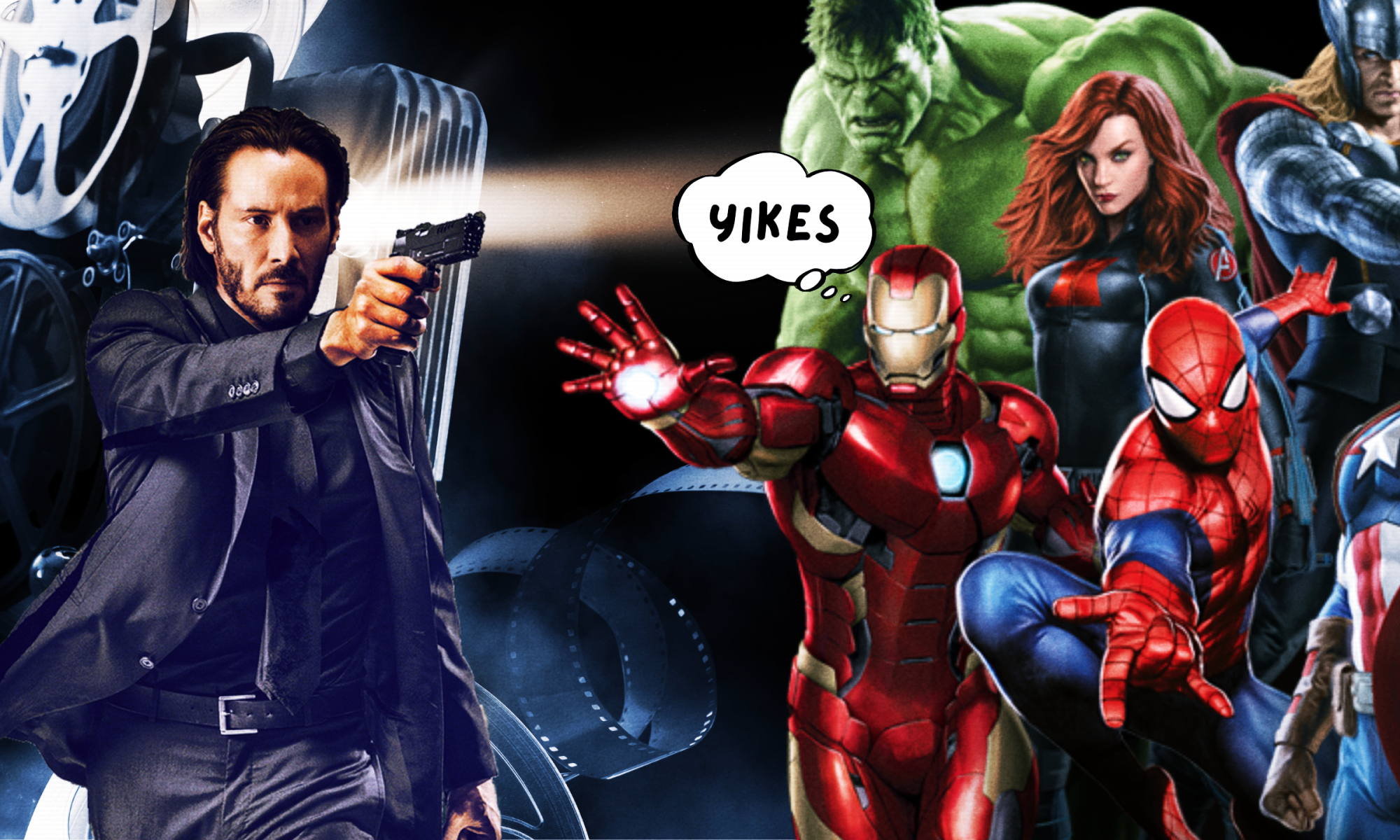

If you’ve ever had the thought, “oh, a new *insert franchise here* movie? I guess I better watch it,” you’ve likely experienced franchise fatigue. If you’ve ever been watching a film series entry and had the words “they must be contractually obligated” pass through your mind, ditto. Scores of fans across different fanbases are become disillusioned and disengaged with series that were once huge hits.
Franchise fatigue differs from general audience disinterest because the term itself implies there was once excitement and energy from the audience, it’s also marked by a number of unique factors, such as poor reception. Audience and critic scores are generally lower for franchises experiencing fatigue. Using Rotten Tomatoes* and the Marvel Cinematic Universe as a guide, we can see that Captain America: Brave New World (2025) received a critics score of 48% whilst Marvel’s the Avengers (2012) received a critic score of 91%.
Burnout and confusion is another key symptom. I’ve found myself overwhelmed with interconnected storylines that not only bounce around in time but dimensions too. A multiverse is a great idea from a profit standpoint, it allows for infinite films in one franchise, but it’s not so great from the perspective of the viewer. It means so many stories are left open-ended or bearing no impact on the rest of the series – it’s narratively unsatisfying and makes anything that happens of no consequence. Talking of profits, so many new franchise releases are immediately seen as a cash-grab which generates disinterest which goes someway in explaining diminishing sales at the box office.
Going back to the MCU, not only is there a whopping 36 movies as of May 2025, but there have also been 16 different TV series taking place with the Marvel Cinematic Universe. That’s an awful lot of content to even watch let alone enjoy, and results in further diluted interest. The fact of the matter is, the MCU has found a recipe that worked to generate a lot of interest in the past. Staying with the same model only creates repetitive stories and formulaic plots. I’ve been homing in on the MCU but so many other franchises are guilty of the same behaviour.
For some reason (read: money) the powers that be at Disney decided to release five Star Wars films in five years. Hint – that’s too many. There was a lot of excitement when The Force Awakens was released in 2015, it made just over 2 billion dollars at box office and received a critics score on Rotten Tomatoes of 93%. The Rise of Skywalker made just over 1 billion dollars at box office and received a score of 51%. Obviously a billion dollars is an unfathomable amount of money in any context, but to lose a billion dollars on a pop culture phenomenon like Star Wars indicates that something went very wrong.
What went wrong? The Rise of Skywalker was not a good movie. It was rushed, underdeveloped, inconsistent, uninvestable, and kind of an insult. Lucasfilm was aware of oversaturation when The Last Jedi (2017) was released to mixed reviews, yet they still fired out two more movies. Then there’s the streaming overload, with so many series coming out, it’s a struggle to keep up with interconnected timelines and stories and makes what was once an enjoyable franchise feel like a chore. It’s a great example of a sunk cost fallacy – I’ve spent so much time watching all of these, I guess I better watch that one too. It feels like a satisfying conclusion is on the horizon but there’s always a post-credit scene that won’t put us out of our misery. The Star Wars sequel trilogy is to cinema what the Funko Pop is to Barbara Hepworth.
Perhaps one of the guiltiest culprits of franchise fatigue is the horror genre and this is because horror franchises work particularly well from a business point of view. They generally have low budgets and high returns, strong fanbases, and big merchandising opportunities. In terms of narrative, horror lends itself well to open-ended storylines and there’s not much danger of jumping the shark. Halloween has 13 films, Texas Chainsaw Massacre 9, and Friday the 13th 12. Most of these franchises have had to really focus on the nostalgia gambit for any kind of engagement and even then it’s to poor receptions because they mostly value commerciality over originality. There have been some recent movies that have had warm receptions, like Halloween (2018) but the popcorn munching slasher seems to have been on a downward trajectory since the 1980s, and the arrival of more recent franchises (Saw, The Conjuring) have followed in the same way. It’s also worth noting here that franchise fatigue seems to be less of an issue for some particular franchises. Friday the 13th (1980) was made after the success of Halloween (1978), and because it was seen as a largely commercial movie at the time, so most audiences don’t feel hoodwinked.
There are so many streaming channels available that the film and tv market has altered drastically and whilst some studios have been strategizing against franchise fatigue, it really only requires a twostep plan: (1) make less movies, and (2) the ones you do make, make them well. This includes valuing quality over quantity and a willingness to evolve creatively. John Wick and Mad Max are some good examples of franchises that still have engaged fanbases. At this point, studios need to find a balance between franchise identity and originality if they want to avoid the dreaded fatigue. Prove to audiences that the latest entry isn’t purely driven by the merchandising potential, demonstrate clear narrative arcs, and encourage character growth.
So, is franchise fatigue a warning or an opportunity? I think both. It’s a warning to franchises that are unwilling to promote creative quality and are over reliant on nostalgia. It’s an opportunity to expand on originality, to evolve and develop character and narrative arcs. My hope is that the rising prevalence of franchise fatigue will give way to a more original, creative space for franchises to blossom into something better. Even if that’s not the case, we are currently in a sort of indie-boom revival space where companies like A24 are putting out new, original content and championing filmmakers who don’t have the surname Snyder or Abrams.
What franchises have you had enough of? Comment below!
 Screen Waffle